


A contract signed with a Brazilian company should do more than describe a commercial agreement.
It should identify who is legally responsible, what must be delivered, when payment becomes due, which evidence will prove performance and what happens if the transaction fails.
Chinese manufacturers, suppliers, investors and Hong Kong companies frequently use international contract templates when negotiating with Brazilian customers, distributors or business partners.
Those templates may be commercially familiar, but they are not always prepared for enforcement under Brazilian law.
Willian Nunes Advogados assists Chinese and Hong Kong companies with contract drafting, contract review, negotiations, due diligence and commercial disputes involving Brazilian parties.
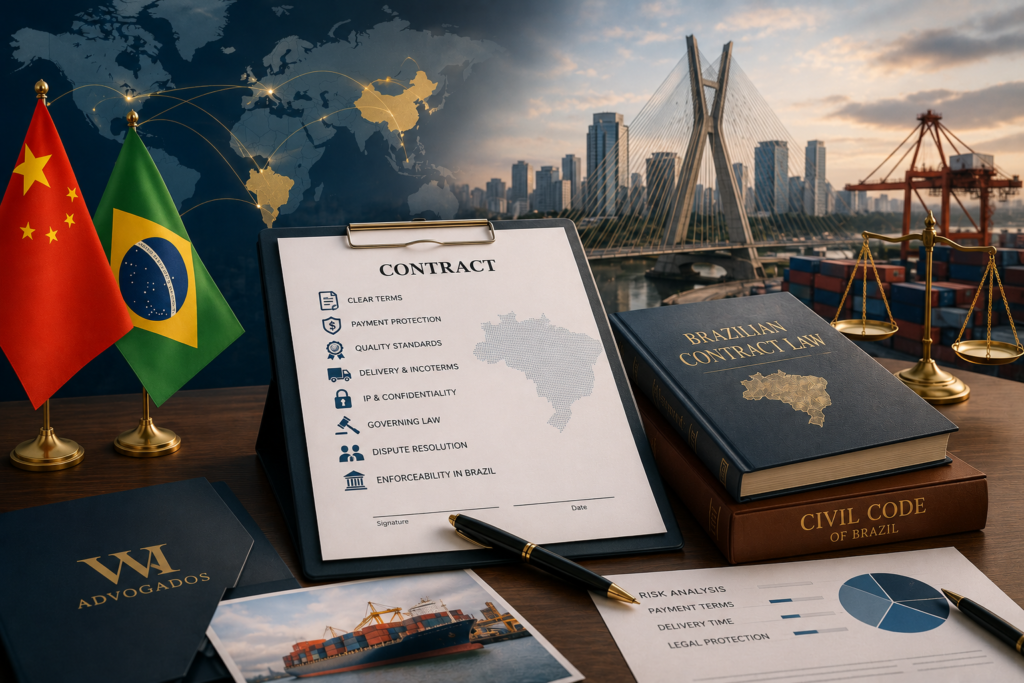
A signed contract does not automatically mean a protected transaction
A contract may contain dozens of pages and still fail to address the risks that matter most.
Common problems include:
- the wrong Brazilian company signing the agreement;
- a person signing without sufficient authority;
- unclear technical specifications;
- no objective acceptance procedure;
- payment obligations linked to vague conditions;
- inconsistent language versions;
- inadequate guarantees;
- no procedure for defective products;
- an unenforceable penalty;
- unclear tax and import responsibilities;
- inappropriate jurisdiction;
- an arbitration clause that is too expensive for the transaction;
- no evidence-preservation requirements;
- no practical method for recovering money in Brazil.
Brazilian contract law recognizes contractual freedom, but that freedom operates within legal limits. The Brazilian Civil Code also requires the parties to act with probity and good faith during the formation and performance of the contract.
A contract involving Brazil should therefore be reviewed according to the transaction, the Brazilian counterparty and the remedies that may actually be available.
When should a Chinese company request Brazilian contract review?
Legal review is particularly relevant before a Chinese or Hong Kong company:
- sells machinery or equipment to Brazil;
- appoints a Brazilian distributor;
- hires a commercial representative;
- licenses technology or software;
- enters into a manufacturing arrangement;
- provides engineering or technical services;
- invests in a Brazilian company;
- signs a joint venture;
- purchases products from a Brazilian supplier;
- grants exclusivity in Brazil;
- accepts deferred payment;
- delivers goods before receiving full payment;
- authorizes the use of its trademark;
- shares confidential technical information;
- renews or terminates an existing commercial relationship.
The review should occur before signature, shipment, disclosure of sensitive information or transfer of funds.
Once the commercial risk has materialized, the legal analysis changes from prevention to dispute management.
Confirm the identity of the Brazilian counterparty
The commercial name used in negotiations may not be the legal entity responsible for the transaction.
A business group may operate through several Brazilian companies with similar names. One entity may negotiate the transaction while another signs the contract, receives the products or issues the purchase order.
Before signing, the Chinese company should confirm:
- the complete legal name;
- the CNPJ registration;
- registered address;
- shareholders;
- managers;
- corporate status;
- authority of the signatory;
- whether another group company should provide a guarantee;
- whether the company owns relevant assets;
- whether it is involved in material litigation or insolvency proceedings.
The contract should identify the exact legal entity that will assume the obligations.
A signature from an employee, salesperson or consultant does not necessarily prove that the Brazilian company is legally bound. The authority of the signatory should be compared with the company’s corporate documents or a valid power of attorney.
This verification can be combined with legal due diligence before products are delivered or significant credit is granted.
Define the commercial scope without ambiguity
Many contract disputes begin because the parties agreed on the general business opportunity but not on the details of performance.
The agreement should clearly describe:
- products or services;
- quantity;
- technical specifications;
- quality standards;
- drawings and project documents;
- production schedule;
- packaging;
- inspection;
- testing;
- delivery;
- installation;
- training;
- maintenance;
- replacement parts;
- acceptance;
- warranty;
- after-sales assistance.
Attachments, quotations and technical proposals should be expressly incorporated into the contract.
The document should also establish which text prevails when the purchase order, proposal, technical specification and main agreement contain inconsistent terms.
For industrial transactions, the acceptance procedure is especially important.
The contract should state:
- who conducts the inspection;
- where testing occurs;
- which standards apply;
- how defects are reported;
- how long the buyer has to reject the goods;
- whether minor defects allow total rejection;
- when acceptance becomes final;
- who pays for repairs, replacement or return transportation.
Without objective criteria, a Brazilian customer may attempt to delay payment by alleging that acceptance has not occurred.
Price, currency and payment protection
The contract should identify more than the total price.
It should establish:
- currency;
- payment schedule;
- deposit;
- milestone payments;
- conditions for invoicing;
- banking charges;
- withholding taxes;
- exchange-rate responsibility;
- late-payment interest;
- contractual penalties;
- payment guarantees;
- consequences of delayed payment;
- right to suspend performance;
- right to terminate;
- treatment of partial delivery.
When payment occurs after manufacturing or shipment, the supplier should evaluate whether additional protection is required.
Possible safeguards may include:
- advance payment;
- letter of credit;
- bank guarantee;
- corporate guarantee;
- personal guarantee;
- retention of title where legally and operationally appropriate;
- acknowledgement of debt;
- collateral;
- insurance;
- documentary conditions;
- staged delivery.
The appropriate guarantee depends on the value, assets, transaction structure and financial condition of the Brazilian customer.
A promise that the customer “will pay after delivery” is not a payment-security strategy.
Import, shipping and customs responsibilities
Contracts involving physical goods should clearly allocate responsibility for international transport and Brazilian import procedures.
The parties should determine:
- applicable Incoterm;
- export clearance;
- international freight;
- insurance;
- Brazilian customs clearance;
- import licenses;
- taxes;
- storage;
- port expenses;
- demurrage;
- inland transportation;
- risk of loss;
- transfer of ownership;
- responsibility for incorrect documentation.
Using an Incoterm does not resolve every legal and operational question.
The contract should still clarify the delivery location, documentation, customs cooperation and consequences of delay.
Chinese suppliers should avoid assuming that the Brazilian buyer has all registrations, licenses and technical approvals necessary to import the product.
Those matters should be verified before manufacturing begins.
Distribution and commercial representation are not the same
A Brazilian distributor generally purchases and resells products in its own name.
A commercial representative typically promotes or intermediates transactions on behalf of the represented company in exchange for commissions.
The distinction cannot be determined only by the title printed on the agreement. The actual activities, payment structure, independence and commercial relationship must be examined.
Brazilian commercial-representation legislation imposes specific requirements and protects certain rights of commercial representatives, including compensation in some termination scenarios. The law provides that, outside the legally defined just-cause situations, contractual indemnification may not be lower than one-twelfth of the remuneration received during the relationship.
A Chinese company should therefore not use a generic “consultant,” “agent” or “distributor” template without confirming how the Brazilian partner will actually operate.
The contract should address:
- territory;
- exclusivity;
- customers;
- sales targets;
- commissions or resale margins;
- approval of orders;
- authority to bind the foreign company;
- marketing obligations;
- inventory;
- expenses;
- trademark use;
- reporting;
- compliance;
- termination;
- post-termination obligations.
An unsuitable classification may create liabilities that were not considered when the relationship began.
Exclusivity should have measurable conditions
Granting exclusivity across Brazil can prevent the foreign company from appointing another partner in a large and commercially diverse market.
Exclusivity should ordinarily be connected to objective obligations such as:
- minimum purchases;
- annual sales;
- geographic coverage;
- marketing investment;
- qualified personnel;
- inventory levels;
- technical support;
- reporting;
- regulatory compliance;
- payment performance.
The contract should explain when exclusivity begins, when it may be suspended and when it automatically ends.
A partner that does not purchase, promote or pay should not remain protected by an indefinite exclusivity clause.
Protect trademarks, technology and confidential information
Chinese manufacturers and technology companies may disclose:
- product drawings;
- manufacturing processes;
- pricing;
- customer lists;
- source code;
- technical manuals;
- formulas;
- prototypes;
- commercial strategies;
- supplier information.
A confidentiality clause should identify what information is protected, how it may be used, who may receive it and what happens after termination.
The contract should also determine ownership of:
- trademarks;
- software;
- technical improvements;
- custom developments;
- local marketing materials;
- translations;
- domain names;
- social-media accounts;
- customer databases;
- product registrations.
Under Brazilian industrial-property law, trademark ownership is generally acquired through valid registration, and trademark owners or applicants may enter into licensing arrangements.
Authorizing a Brazilian distributor to use a brand is not the same as transferring ownership of that brand.
The agreement should prohibit unauthorized registrations and require the return or transfer of digital assets, registrations and marketing materials at the end of the relationship.
Personal data and cross-border operations
A commercial agreement may involve personal data belonging to employees, customers, users, representatives or technical contacts.
The Brazilian General Data Protection Law may become relevant when personal data is processed in connection with Brazilian activities.
The contract may need to define:
- purpose of the processing;
- categories of data;
- controller and processor roles;
- security obligations;
- incident reporting;
- subcontractors;
- international transfers;
- retention;
- deletion;
- cooperation with data-subject requests.
The LGPD regulates the processing of personal data and includes rules relevant to contractual processing and international transfers.
A confidentiality clause alone is not necessarily sufficient to regulate data-protection responsibilities.
Governing law, courts and arbitration
Dispute-resolution clauses should be selected according to the transaction rather than copied from another contract.
The parties should evaluate:
- transaction value;
- location of assets;
- expected type of dispute;
- language;
- cost;
- need for confidentiality;
- need for urgent relief;
- technical complexity;
- number of parties;
- enforceability of the final decision.
Brazilian courts
Brazilian jurisdiction may be commercially practical when the counterparty and assets are located in Brazil.
The contract should identify the chosen forum and avoid conflicting clauses.
International arbitration
Arbitration may be appropriate for high-value, technically complex or confidential international transactions.
The arbitration clause should identify:
- arbitral institution;
- seat;
- language;
- number of arbitrators;
- governing procedural rules;
- method of appointment;
- allocation of costs;
- availability of emergency measures.
Brazil has specific arbitration legislation and is a party to the New York Convention on the Recognition and Enforcement of Foreign Arbitral Awards.
An arbitral award issued outside Brazil generally requires recognition by the Superior Court of Justice before it can be enforced against assets in Brazil.
Arbitration can be effective, but it may be disproportionate for a relatively small unpaid invoice.
The clause should reflect the actual economic value and risk of the transaction.
Electronic signatures and evidence
Contracts can be signed electronically, but the signature process should preserve reliable evidence of:
- identity;
- authority;
- date and time;
- document integrity;
- acceptance;
- audit trail;
- IP address or authentication method;
- final signed version.
The Brazilian Superior Court of Justice has recognized that an electronic signature should not be considered invalid merely because the certification provider is not accredited within ICP-Brasil, particularly when the parties agreed to the method and other verification elements support authenticity.
The method of signature may also affect how the contract can be enforced.
Under Article 784 of the Brazilian Code of Civil Procedure, a private document signed by the debtor and two witnesses is generally an extrajudicial enforceable title. The legislation was amended in 2023 to address electronically constituted or certified titles and the use of legally recognized electronic signatures.
This does not mean that every electronic contract automatically permits immediate enforcement.
The content of the obligation, evidence of default, signature method and documentary structure must still be assessed.
Prepare the contract for a possible dispute
A contract should not merely state what the parties expect to happen.
It should also organize the evidence required if the expected performance does not occur.
The agreement may require the parties to retain:
- purchase orders;
- invoices;
- shipping documents;
- inspection reports;
- delivery receipts;
- acceptance records;
- technical communications;
- payment confirmations;
- notices;
- meeting minutes;
- platform records.
Formal notices should be sent through the channels specified in the contract.
Informal messaging applications may be useful evidence, but they should not be the only record of a major contractual decision.
Contract termination must be planned before the relationship begins
Termination provisions should distinguish:
- termination without cause;
- termination for breach;
- insolvency;
- repeated late payment;
- failure to meet sales targets;
- regulatory violations;
- corruption or sanctions concerns;
- unauthorized trademark use;
- confidentiality breaches;
- change of control;
- force majeure;
- prolonged impossibility of performance.
The contract should determine:
- notice period;
- opportunity to cure;
- outstanding payments;
- pending orders;
- inventory;
- customer relationships;
- return of documents;
- intellectual property;
- confidential information;
- technical support;
- post-termination commissions;
- survival of selected clauses.
A termination clause that simply says either party may end the contract may leave the most important consequences unanswered.
What does Brazilian contract review include?
The legal review may include:
- verification of the Brazilian counterparty;
- confirmation of signatory authority;
- identification of Brazilian mandatory rules;
- analysis of the commercial structure;
- review of payment and guarantees;
- revision of technical and acceptance provisions;
- review of taxes and operational responsibilities;
- analysis of distribution or representation risks;
- intellectual-property protection;
- confidentiality and data-protection clauses;
- termination and liability provisions;
- governing-law and dispute-resolution analysis;
- signature and enforceability review;
- preparation of revised contractual language;
- negotiation support with the Brazilian party.
The scope can be limited to identifying major risks or expanded to include complete redrafting and negotiation.
Documents required for contract review
The company should provide:
- current draft;
- previous versions;
- quotation;
- purchase order;
- technical proposal;
- product specifications;
- relevant emails;
- company details;
- information about the Brazilian counterparty;
- transaction value;
- payment structure;
- delivery schedule;
- commercial objectives;
- known concerns;
- deadline for signature.
The lawyer should understand the business transaction, not merely correct the wording.
How Willian Nunes Advogados assists Chinese companies
Willian Nunes Advogados assists Chinese manufacturers, suppliers, investors and Hong Kong companies with:
- contract drafting;
- contract review;
- bilingual agreements;
- negotiation with Brazilian parties;
- supplier and customer due diligence;
- distribution agreements;
- commercial representation agreements;
- technology and licensing contracts;
- equipment sales;
- service agreements;
- NDAs;
- guarantees;
- acknowledgements of debt;
- termination agreements;
- contract enforcement;
- commercial disputes.
The firm may work directly with the company or coordinate the Brazilian legal scope with its lawyers, accountants and consultants in China or Hong Kong.
Companies requiring broader legal support may review our general guide concerning legal services in Brazil for Chinese and Hong Kong companies.
The firm also maintains a specific page concerning contract-law services for foreign companies.
Frequently asked questions
Can a Brazil–China contract be written only in English?
The parties may use an English-language commercial contract.
However, a Portuguese translation may be necessary when the document is presented to a Brazilian court, registry or public authority.
A bilingual contract may reduce operational misunderstandings, provided it clearly states which language prevails.
Can Chinese law govern the contract?
The answer depends on the transaction, dispute-resolution mechanism and connection with Brazil.
A choice-of-law clause should be reviewed together with Brazilian mandatory rules and the intended enforcement strategy.
Should the contract choose Chinese or Brazilian courts?
The answer depends on where the parties, evidence and assets are located.
Choosing a foreign court may require an additional recognition procedure before the decision produces effects in Brazil. The Superior Court of Justice is responsible for the homologation of foreign decisions under the applicable requirements.
Is arbitration always better?
No.
Arbitration may be useful for high-value or complex international transactions, but its costs may be excessive for smaller disputes.
The clause should be proportionate to the commercial relationship.
Can an electronically signed contract be enforced in Brazil?
Electronic contracts may be legally valid.
Whether the agreement permits direct enforcement depends on its content, signature process, evidence of integrity and the procedural requirements applicable to the document.
Should the Brazilian customer provide a guarantee?
A guarantee should be considered whenever payment will occur after production, shipment, delivery or installation.
The appropriate form depends on the customer’s financial position, transaction value and available assets.
Can a contract prevent every commercial risk?
No.
A contract cannot eliminate insolvency, fraud, operational failure or market risk. It can allocate responsibilities, preserve evidence, establish remedies and improve the company’s ability to respond.
Review the Brazilian contract before assuming the risk
The most expensive contractual problem is often the one discovered after the goods have been manufactured, the technology disclosed, the exclusivity granted or the payment missed.
Before signing with a Brazilian company, confirm:
- who is legally responsible;
- who has authority to sign;
- what evidence proves performance;
- what protects payment;
- which law and procedure apply;
- where assets are located;
- what happens if the relationship ends.
Willian Nunes Advogados provides Brazilian contract review for Chinese and Hong Kong companies negotiating with customers, suppliers, distributors, representatives and investment partners in Brazil.
Submit the contract, company information, transaction value and intended deadline for an initial scope assessment.
Legal notice
This content provides general information and does not constitute individualized legal advice.
Contractual rights and risks depend on the parties, documents, transaction structure, applicable law, evidence and circumstances of each matter.