


Due diligence Brazil is the legal review conducted before a foreign investor, buyer, company or family signs a contract, purchases real estate, acquires shares, enters a partnership or sends funds to Brazil. It helps identify legal risks, hidden debts, ownership problems, tax exposure, litigation, regulatory issues and document inconsistencies before the transaction is completed.
For foreign clients, due diligence is especially important because Brazilian law follows a civil law system, uses Portuguese-language documents, depends heavily on public registries and often requires formal certificates, notarized documents, sworn translations and powers of attorney.
Imagine a foreign investor negotiating the purchase of a property in Brazil based only on a seller’s promise and a simple private agreement. Without checking the real estate registry, tax certificates, seller’s litigation history and municipal restrictions, the investor may discover later that the asset has liens, debts, irregular construction or ownership disputes. Due diligence exists to reduce that kind of risk before money changes hands.
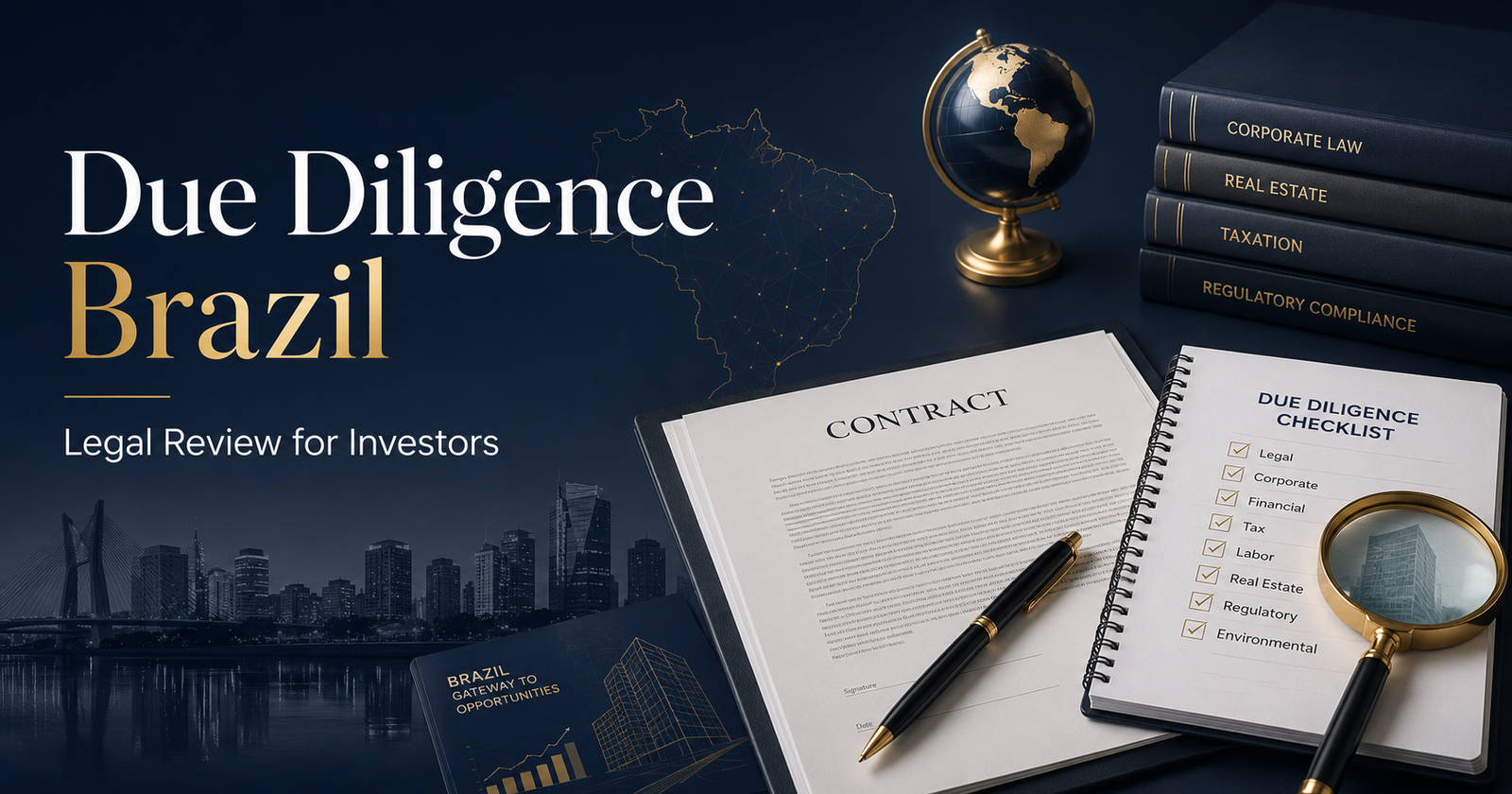
What does due diligence mean in Brazil?
Due diligence in Brazil is a structured legal investigation of a person, company, asset, contract or transaction. The goal is not to “approve” or “guarantee” a deal, but to identify risks and support an informed decision.
In practice, a legal due diligence review may involve:
- checking corporate registration;
- reviewing CNPJ status;
- analyzing powers of attorney;
- reviewing contracts and obligations;
- checking real estate registry documents;
- reviewing tax certificates;
- identifying lawsuits and enforcement proceedings;
- checking debts, liens and encumbrances;
- analyzing regulatory restrictions;
- reviewing data protection risks;
- assessing whether the transaction structure is legally consistent.
For foreign investors, the legal review should also consider language barriers, applicable Brazilian formalities, currency movement, representation in Brazil and the difference between foreign expectations and Brazilian legal requirements.
When is legal due diligence necessary in Brazil?
Legal due diligence is recommended whenever a foreign investor or company is about to assume legal, financial or operational exposure in Brazil.
Buying real estate in Brazil
Real estate due diligence in Brazil is one of the most common needs for foreign buyers. The lawyer verifies the property title, ownership chain, liens, lawsuits, tax debts, zoning restrictions and registry inconsistencies.
In Brazil, real estate ownership and restrictions are not analyzed only through the purchase agreement. The property registry, certificates and public records are central to understanding whether the transaction is safe.
A foreign buyer should not rely only on photos, advertisements, promises or informal messages. The legal review should happen before signing binding documents or sending substantial payments.
For a deeper guide on this topic, see real estate due diligence in Brazil.
Investing in a Brazilian company
Corporate due diligence is necessary when buying shares, entering a joint venture, acquiring a business, investing in a startup, appointing a local partner or contracting with a Brazilian company.
The review may include CNPJ status, corporate documents, articles of association, shareholder structure, powers of managers, debts, tax liabilities, labor exposure, pending lawsuits, contracts and regulatory compliance.
Brazilian companies are subject to public registration rules, tax obligations and corporate formalities. A business may appear commercially attractive but still carry hidden legal or financial liabilities.
Signing commercial contracts
Foreign companies often use contract models drafted under U.S., European or common law assumptions. In Brazil, contract interpretation, enforcement and formal requirements may differ.
Before signing a distribution agreement, service agreement, purchase agreement, representation contract or partnership document, legal due diligence helps verify whether the document is compatible with Brazilian law and whether the parties have authority to sign.
This is particularly relevant when contracts involve payment obligations, exclusivity, penalty clauses, jurisdiction, arbitration, intellectual property, confidentiality, service delivery or debt recovery.
Hiring a local representative or partner
Foreign companies sometimes appoint a Brazilian representative, consultant, distributor, manager or attorney-in-fact without reviewing the legal consequences.
A poorly drafted power of attorney or representation agreement may expose the foreign company to commercial, tax, labor or reputational risks. Due diligence helps define the scope of authority, limits of representation, termination rules and accountability.
What should be reviewed during due diligence in Brazil?
The scope depends on the transaction. A real estate purchase, company acquisition, commercial contract and inheritance-related asset transfer require different checks.
Corporate and CNPJ verification
For companies, due diligence usually starts with CNPJ verification and corporate registration documents. The CNPJ helps identify the legal entity, registration status, business activities and public information available through Brazilian official systems.
The review should not stop there. It is also necessary to verify who can legally represent the company, whether corporate acts are updated, whether the person signing has authority, and whether the company’s documents match the transaction being negotiated.
Foreign investors should be cautious when the company name, trade name, bank account, representative and contractual party do not clearly match.
Real estate title and registry documents
For real estate, the key document is the property registry certificate, known as the matrícula. It may reveal ownership history, mortgages, liens, restrictions, lawsuits, usufruct, judicial attachments or inconsistencies that affect the transaction.
The due diligence review may also include municipal tax records, zoning rules, construction permits, condominium debts, environmental restrictions and seller-related certificates.
A purchase agreement alone does not replace registry analysis.
Tax and debt certificates
Tax and debt certificates help identify whether a person or company has pending tax issues that may affect the transaction.
In corporate and real estate transactions, federal, state, municipal, labor and litigation-related certificates may be relevant. The exact list depends on the asset, parties and structure of the deal.
The purpose is to verify whether debts, lawsuits or public liabilities may affect the buyer, the asset or the transaction.
Contracts, lawsuits and liabilities
Due diligence should also review contracts, pending disputes, unpaid obligations, guarantees, loans, labor claims, supplier disputes and customer claims.
For company acquisitions, this stage is critical. The buyer may be acquiring not only assets or shares, but also legal exposure connected to past operations.
For foreign companies entering Brazil, this review helps decide whether the transaction should proceed, be renegotiated, require guarantees, or be abandoned.
Data protection and regulatory issues
If the transaction involves customer data, employees, health data, technology, platforms, marketing databases or digital operations, Brazilian data protection rules may also be relevant.
The Brazilian General Data Protection Law, known as LGPD, applies to the processing of personal data by individuals or legal entities, including digital operations. For investors, this means that data, privacy and compliance issues can become part of legal due diligence.
Why foreign investors should not rely only on the seller’s documents
A common mistake is assuming that documents provided by the seller are enough. In many cases, they are not.
The buyer or investor should independently verify public records, certificates, registry documents, corporate authority, tax status and litigation risks. This is especially important when the investor is outside Brazil and cannot personally inspect offices, registries, notaries or courts.
Due diligence is not based on distrust. It is a standard legal protection mechanism. A serious seller, partner or company should understand that foreign investors need documents reviewed before committing funds.
How a Brazilian lawyer assists with due diligence
A Brazilian lawyer assists foreign investors by identifying the correct documents, reviewing legal risks, coordinating certificates, checking public records, analyzing contracts and communicating the findings in clear language.
The lawyer may also assist with:
- drafting or reviewing powers of attorney;
- coordinating sworn translations;
- communicating with notaries and registries;
- reviewing purchase agreements;
- negotiating risk allocation clauses;
- checking litigation and debt exposure;
- preparing a written legal opinion;
- recommending whether additional accounting, tax or technical review is necessary.
WN Advogados assists Brazilian and international clients in matters involving legal representation, real estate due diligence, business law, corporate matters, contracts and foreign investment in Brazil. The firm is based in Curitiba, Paraná, and provides legal support in Portuguese and English.
For foreign investors, the value of legal due diligence is not only finding problems. It is understanding whether a deal can be structured safely, renegotiated or documented with appropriate protections.
Due diligence in Curitiba, Paraná and across Brazil
Due diligence may be conducted for assets, companies and transactions located in Curitiba, Paraná, São Paulo, Rio de Janeiro, Santa Catarina and other Brazilian states.
The local aspect matters because real estate registries, state taxes, municipal rules, commercial boards and courts may vary according to the location of the asset or company. A transaction involving a property in Curitiba, a company in São Paulo and a foreign buyer in the United States may require coordinated legal analysis across different authorities.
WN Advogados, based in Curitiba, assists foreign clients with Brazilian legal matters, including legal representation in Brazil, lawyer consultation in Brazil, legal advisory services for foreign companies in Brazil, lawyer in Brazil and real estate due diligence in Brazil.
Before signing contracts, transferring funds or accepting documents from a seller or partner, foreign investors should seek a case-specific review.
Speak with a lawyer in Brazil to evaluate the documents, transaction structure and legal risks involved in your case.
Links internos utilizados
- real estate due diligence in Brazil
- legal representation in Brazil
- lawyer consultation in Brazil
- legal advisory services for foreign companies in Brazil
- lawyer in Brazil
- Speak with a lawyer in Brazil
Links externos oficiais utilizados
- Brazilian Civil Code — Planalto
- Public Registries Law — Law No. 6.015/1973 — Planalto
- Brazilian Corporate Registration Law — Law No. 8.934/1994 — Planalto
- Brazilian Corporations Law — Law No. 6.404/1976 — Planalto
- CNPJ consultation — Gov.br
- Federal tax clearance certificate — Gov.br
- LGPD — Law No. 13.709/2018 — Planalto
Fontes oficiais confirmam pontos centrais do artigo: a Lei de Registros Públicos permite a emissão de certidões de registros, a Receita/Gov.br disponibiliza consulta de CNPJ e QSA, a certidão de regularidade fiscal perante a Fazenda Nacional comprova situação fiscal perante RFB e PGFN, e a LGPD regula o tratamento de dados pessoais por pessoa física ou jurídica.
FAQ about due diligence in Brazil
Objective answers for foreign investors, companies and buyers who need legal review before signing contracts, purchasing assets or entering transactions in Brazil.
What is due diligence in Brazil?
Due diligence in Brazil is a legal review of documents, public records, contracts, assets, companies, debts and risks before a transaction is completed. It helps foreign investors understand whether the deal has legal, tax, corporate, real estate, litigation or regulatory issues that should be addressed before signing or paying.
Do foreign investors need due diligence before buying property in Brazil?
Yes. Foreign buyers should verify the property registry, ownership history, liens, tax debts, lawsuits, zoning restrictions and seller-related documents before purchasing real estate in Brazil. A private contract or seller’s statement is not enough to confirm that a property is legally safe.
What documents are reviewed in Brazilian real estate due diligence?
The review usually includes the property registry certificate, seller documents, municipal tax records, condominium debts, lawsuits, liens, environmental restrictions, zoning rules and purchase agreement. The exact list depends on the location, property type and transaction structure.
What is corporate due diligence in Brazil?
Corporate due diligence reviews a Brazilian company before investment, acquisition, partnership or contract. It may include CNPJ status, articles of association, shareholder structure, management authority, debts, lawsuits, tax certificates, labor exposure, contracts and regulatory issues.
Can a foreign company conduct due diligence in Brazil remotely?
In many cases, yes. A foreign company can appoint a Brazilian lawyer through a power of attorney, allowing local review of registries, certificates, contracts and public records. Some documents may require apostille, sworn translation or notarization depending on the transaction.
How long does due diligence in Brazil take?
The timeframe depends on the transaction, document availability, location of the asset, public registry response and complexity of the risks involved. Simple document reviews may be faster, while real estate, corporate or litigation-heavy reviews may require additional time and certificates.
Does due diligence guarantee that a transaction is risk-free?
No. Due diligence does not guarantee a risk-free transaction or a specific outcome. Its purpose is to identify relevant risks, document inconsistencies and legal exposure so the client can make an informed decision, renegotiate terms, request guarantees or avoid the transaction.
When should a lawyer be contacted for due diligence in Brazil?
A lawyer should be contacted before signing a contract, transferring funds, accepting powers of attorney, buying property, acquiring shares or entering a partnership in Brazil. Early legal review helps prevent avoidable risks and gives the investor more leverage before commitments are made.
Can due diligence identify lawsuits and debts in Brazil?
Yes. Depending on the scope, due diligence may include litigation searches, tax certificates, debt checks, property liens, corporate records and public information. The availability and relevance of each search depend on the person, company, asset and Brazilian jurisdiction involved.
How can WN Advogados help with due diligence in Brazil?
WN Advogados assists foreign clients with legal due diligence in Brazil, including real estate checks, corporate review, contract analysis, powers of attorney, document verification and legal representation. The strategy depends on the documents, asset, parties and transaction structure.