
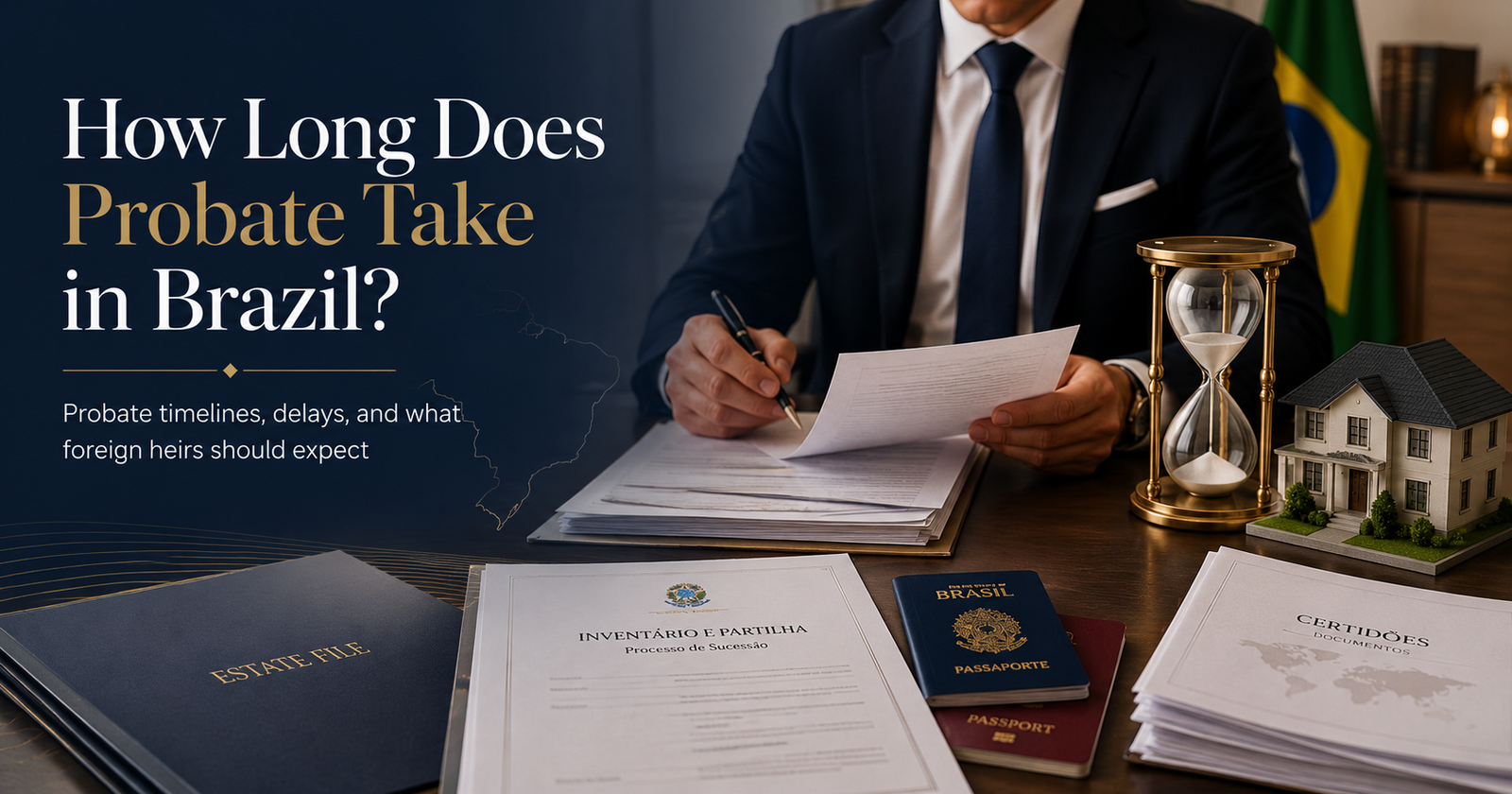
How long does probate take in Brazil? In simple cases, probate may take a few months when all heirs agree, documents are complete and the procedure can be handled before a notary. In more complex or disputed cases, judicial probate may take one to three years or longer, depending on court workload, missing documents, tax issues, foreign heirs, real estate records and family disputes.
There is no guaranteed probate timeline in Brazil. The duration depends on the type of procedure, the assets involved, the location of the estate, the heirs’ cooperation and whether foreign documents need apostille, sworn translation or court recognition.
Imagine a U.S. family whose parent owned an apartment in Brazil. The heirs live abroad, the death certificate was issued outside Brazil, one heir does not yet have a CPF, and the property registry still contains outdated information. Even if the family agrees on the division, the probate process may take longer because documents must be regularized before the estate can be transferred.
Direct answer: how long probate usually takes in Brazil
Probate in Brazil may follow two main paths: extrajudicial probate before a notary or judicial probate before a court.
As a general estimate:
- Extrajudicial probate may take a few months when all legal requirements are met.
- Judicial probate may take one to three years in many cases.
- Complex probate involving disputes, foreign documents, multiple properties or business assets may take longer.
Brazilian law sets procedural rules for inventory and partition. The Brazilian Code of Civil Procedure provides rules for judicial and extrajudicial probate, including the possibility of probate by public deed when the legal requirements are satisfied. See the Brazilian Code of Civil Procedure on the official Planalto website: Lei nº 13.105/2015 — Código de Processo Civil.
The same Code also provides that inventory and partition should be opened within two months from the opening of succession and completed within the subsequent twelve months, although the judge may extend this period. In practice, many cases exceed this timeframe, especially when there are disputes, foreign elements, tax issues or missing documents.
Why probate timelines vary in Brazil
Probate in Brazil is not only a formality. It involves identifying heirs, listing assets, calculating inheritance tax, paying debts, preparing the partition and transferring ownership of assets.
Extrajudicial probate before a notary
Extrajudicial probate is usually faster because it is handled at a notary office instead of through a court case.
It may be possible when the heirs agree, the documents are complete and the situation fits the requirements of Brazilian law and CNJ rules. The National Council of Justice regulates notarial acts involving probate and partition through Resolution No. 35/2007, later amended by Resolution No. 571/2024. See the official CNJ rule: Resolução CNJ nº 35/2007.
CNJ Resolution No. 571/2024 updated Resolution No. 35/2007 and expressly states that, for notarial acts related to probate and partition, the parties may freely choose the notary office, without applying the jurisdiction rules of the Code of Civil Procedure. See: Resolução CNJ nº 571/2024.
Even in extrajudicial probate, the notarial deed does not eliminate tax and registration steps. Taxes must be addressed before the deed is completed, and real estate transfers still require registration at the competent property registry.
Judicial probate before a court
Judicial probate is usually required when there is disagreement among heirs, litigation, complex documents, contested wills, asset disputes or other issues requiring court supervision.
Judicial probate tends to take longer because it depends on court deadlines, petitions, judicial decisions, tax review, possible objections and sometimes expert valuation or asset searches.
For foreign heirs, judicial probate may also become necessary when a foreign will or foreign court document needs recognition or when heirs disagree about Brazilian assets.
Probate involving foreign heirs
Probate involving foreign heirs often takes longer because additional formalities may be necessary.
Foreign heirs may need:
- CPF registration;
- passport and identification documents;
- proof of kinship;
- foreign death certificate;
- marriage certificate or divorce decree;
- apostille under the Hague Apostille Convention;
- sworn translation into Portuguese;
- power of attorney for a Brazilian lawyer;
- review of foreign wills or estate documents.
The Brazilian government explains that foreign documents intended to produce effects in Brazil generally need legalization or apostille and translation into Portuguese by a sworn translator registered with the Brazilian state commercial boards. See the official Gov.br page on legalization, apostille and translation: Legalização, Apostilamento e Tradução.
What can delay probate in Brazil?
Several factors can affect the probate timeline.
Missing documents
Missing documents are one of the most common causes of delay. Probate cannot move efficiently if the lawyer does not have the death certificate, heir identification documents, property records, bank information, company documents, tax records and proof of family relationship.
In international cases, even basic documents may take time because they must be issued abroad, apostilled and translated.
Disagreement among heirs
Probate becomes slower when heirs disagree about who should act as estate administrator, how assets should be valued, whether a property should be sold, or how the estate should be divided.
Disputes can turn a case that might have been handled at a notary into judicial probate.
Foreign death certificates, apostilles and sworn translations
Foreign documents are a frequent source of delay. A death certificate issued in the United States, Europe or another country usually cannot simply be filed in Brazil as-is.
It may need apostille, sworn translation and legal review before being accepted in probate. The CNJ explains that the Hague Apostille Convention simplifies the legalization of documents among signatory countries and allows mutual recognition of public documents. See: Apostila da Haia — CNJ.
ITCMD inheritance tax
Inheritance tax in Brazil is called ITCMD. It is a state-level tax and usually must be calculated and paid before assets are transferred.
Tax review can delay probate when the estate includes real estate, company shares, bank assets, rural property or assets with unclear valuation.
The tax authority may require documents, valuations or corrections before approving the declaration.
Real estate, companies and bank assets
Probate involving real estate may take longer because property registry records must be reviewed and updated.
Probate involving company shares may require corporate documents, commercial registry records and valuation of business interests.
Bank assets may require court or notarial authorization, tax clearance and communication with financial institutions.
Can foreign heirs handle probate in Brazil remotely?
In many cases, yes. Foreign heirs may handle probate in Brazil remotely by granting a power of attorney to a Brazilian lawyer.
This can allow the lawyer to:
- represent the heir in court or before a notary;
- request documents;
- communicate with tax authorities;
- review property and corporate records;
- file probate petitions;
- coordinate ITCMD payment;
- sign procedural documents within the authority granted;
- follow up with registries and banks.
Foreign heirs should not assume that remote handling means the process is automatic. The power of attorney must be correctly drafted, and foreign documents must comply with Brazilian formalities.
For related guidance, see legal representation in Brazil and lawyer in Brazil.
How a Brazilian probate lawyer can reduce delays
A Brazilian probate lawyer cannot guarantee a fixed timeline, but legal organization can prevent avoidable delays.
The lawyer may help by:
- identifying whether probate can be extrajudicial or judicial;
- requesting the correct documents from the beginning;
- reviewing foreign documents before submission;
- checking whether heirs need CPF registration;
- coordinating apostille and sworn translation requirements;
- preparing the estate inventory;
- calculating or reviewing ITCMD steps;
- communicating with notaries, courts, registries and tax authorities;
- helping heirs avoid inconsistent or incomplete filings.
For foreign families, legal representation is especially relevant because the probate process involves Brazilian language, procedure, tax rules and registry practice.
WN Advogados assists Brazilian and international clients with probate, inheritance, legal representation, real estate and cross-border family matters in Brazil. The office is based in Curitiba, Paraná, and provides legal communication in Portuguese and English.
For a broader overview, see probate lawyer in Brazil, CPF for inheritance in Brazil, Brazil inheritance tax and real estate due diligence in Brazil.
If your family needs to handle probate involving assets in Brazil, speak with a lawyer in Brazil for a case-specific review of documents, deadlines and possible legal paths.
Links internos utilizados
- probate lawyer in Brazil
- legal representation in Brazil
- lawyer in Brazil
- CPF for inheritance in Brazil
- Brazil inheritance tax
- real estate due diligence in Brazil
- speak with a lawyer in Brazil
Links externos oficiais utilizados
- Lei nº 13.105/2015 — Código de Processo Civil — Planalto
- Resolução CNJ nº 35/2007
- Resolução CNJ nº 571/2024
- Apostila da Haia — CNJ
- Legalização, Apostilamento e Tradução — Gov.br
A Resolução CNJ nº 571/2024 está vigente e altera a Resolução nº 35/2007 sobre atos notariais relacionados a inventário e partilha; seu texto também registra que as escrituras públicas de inventário e partilha não dependem de homologação judicial e são títulos hábeis para transferência de bens e levantamento de valores. A Resolução CNJ nº 35/2007 também prevê que os tributos incidentes devem ser recolhidos antes da lavratura da escritura. Para documentos estrangeiros, Gov.br informa que documentos destinados a produzir efeitos no Brasil precisam, em regra, ser legalizados ou apostilados e traduzidos por tradutor juramentado.
FAQ about how long probate takes in Brazil
Objective answers for foreign heirs, international families and beneficiaries dealing with probate, inheritance and Brazilian assets.
How long does probate take in Brazil?
Probate in Brazil may take a few months in simple extrajudicial cases, but judicial probate may take one to three years or longer. The timeline depends on the documents, heirs, assets, taxes, court workload and whether foreign documents need apostille, sworn translation or legal review.
Is extrajudicial probate faster in Brazil?
Yes. Extrajudicial probate before a notary is usually faster than judicial probate, provided the legal requirements are met, documents are complete and the heirs agree. Even then, inheritance tax, registry steps and asset transfer requirements must still be handled correctly.
When does probate need to go to court in Brazil?
Probate may need to go to court when there is disagreement among heirs, litigation, contested assets, complex documents, disputed wills or other issues requiring judicial supervision. Court probate usually takes longer because it depends on judicial deadlines and decisions.
Can foreign heirs complete probate in Brazil without traveling?
In many cases, foreign heirs can be represented remotely through a power of attorney granted to a Brazilian lawyer. The feasibility depends on the documents, notary or court requirements, asset type and whether foreign documents have been properly apostilled and translated.
What documents can delay probate in Brazil?
Probate may be delayed by missing death certificates, property records, bank information, company documents, marriage certificates, divorce decrees, heir identification documents, CPF registration or foreign documents that still need apostille and sworn translation into Portuguese.
Does inheritance tax delay probate in Brazil?
Yes. ITCMD, the Brazilian inheritance tax, must usually be calculated and addressed before assets are transferred. Tax review may take longer when the estate includes real estate, business interests, bank assets, rural property or assets with valuation issues.
Can a property in Brazil be sold before probate is complete?
Usually, inherited property must go through probate before heirs can formally transfer or sell it. In some situations, judicial authorization or specific contractual structures may be considered, but the legal risks must be reviewed before any sale commitment is made.
Does a foreign will make probate in Brazil longer?
A foreign will may make probate longer because it may require legal review, sworn translation, apostille and sometimes recognition by a Brazilian court. The effect of the will depends on Brazilian succession rules and the assets located in Brazil.
How can a Brazilian probate lawyer reduce delays?
A Brazilian probate lawyer can identify the correct procedure, request documents early, review foreign records, coordinate apostille and translation requirements, handle tax steps, communicate with notaries or courts and reduce avoidable mistakes. No lawyer can guarantee a fixed timeline.
When should heirs contact a lawyer in Brazil?
Heirs should contact a lawyer as early as possible after the death, especially when assets are located in Brazil or heirs live abroad. Early review helps identify deadlines, documents, tax requirements, powers of attorney and whether the probate may be judicial or extrajudicial.